
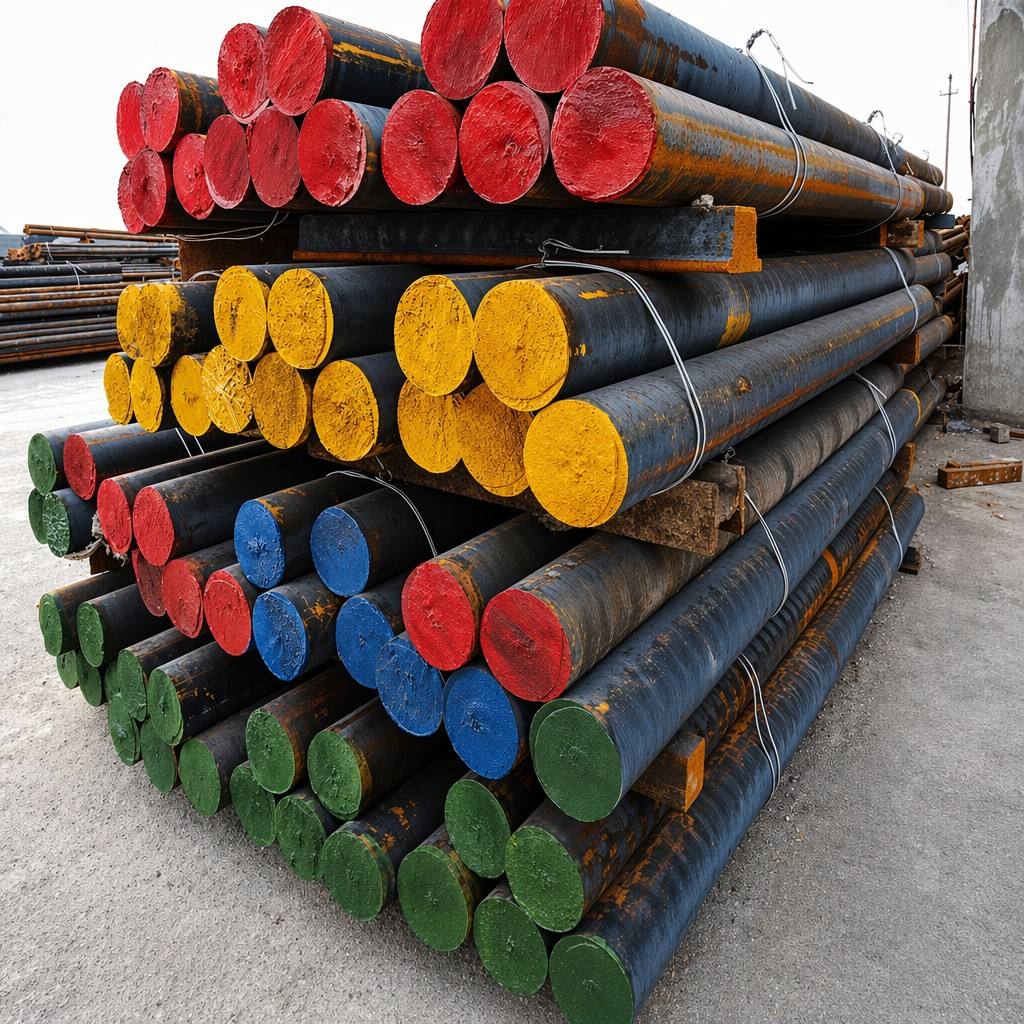
Material Grade
Ductile iron and gray iron grades produced as continuous cast bar — with international cross-references and full specifications.
Overview
Selecting the correct cast iron grade is the single most important decision in any bar-stock machining project. The grade determines tensile strength, hardness, machinability, wear resistance, and ultimately whether the finished part will survive in service or fail prematurely.
This reference guide provides a comprehensive comparison of the gray iron and ductile iron grades we stock, along with equivalent international standard designations to help you cross-reference when working from different country specifications. Every grade listed is available from our continuous cast bar inventory in standard profiles and dimensions.
Buying against a regional standard? See our International Markets reference for ASTM, SAE, EN, DIN and IS grade designations used by buyers in the USA, Europe and India.
Material specification & international cross-reference
Full specification table for our seven core continuous cast bar grades — three gray iron (HT200 / 250 / 300) and four ductile iron (QT400-18 / 450-10 / 500-7 / 600-3) — with equivalent U.S., E.U., German and Japanese designations, chemical composition, mechanical properties and available shapes.
Chemical composition (%)
| Element | HT200 | HT250 | HT300 | QT400-18 | QT450-10 | QT500-7 | QT600-3 |
|---|---|---|---|---|---|---|---|
| Si | 2.0–2.8 | 2.2–2.6 | 2.2–2.6 | 2.0–2.8 | 2.2–3.2 | 2.2–3.2 | 2.2–3.2 |
| Mn | 0.3–0.5 | 0.5–0.8 | 0.6–1.2 | 0.1–0.4 | 0.2–0.4 | 0.3–0.6 | 0.4–0.8 |
| P | ≤0.15 | ≤0.15 | ≤0.15 | ≤0.10 | ≤0.10 | ≤0.10 | ≤0.10 |
| S | ≤0.12 | ≤0.12 | ≤0.10 | ≤0.03 | ≤0.03 | ≤0.02 | ≤0.02 |
| C | 2.8–3.8 | 2.8–3.8 | 2.8–3.8 | 3.3–4.0 | 3.2–3.9 | 3.0–3.9 | 3.0–3.8 |
Mechanical properties
| Property | HT200 | HT250 | HT300 | QT400-18 | QT450-10 | QT500-7 | QT600-3 |
|---|---|---|---|---|---|---|---|
| Yield Strength (MPa) | ≥120 | ≥150 | ≥180 | ≥260 | ≥310 | ≥320 | ≥380 |
| Tensile Strength (MPa) | ≥180 | ≥220 | ≥260 | ≥380 (D 30–150) / ≥350 (D 150–450) | ≥420 (D 30–150) / ≥400 (D 150–450) | ≥470 (D 30–150) / ≥420 (D 150–450) | ≥560 (D 30–150) / ≥520 (D 150–450) |
| Hardness (HB) | 150–180 | 170–220 | 190–240 | 130–170 | 140–200 | 150–230 | 180–250 |
| Elongation (%) | — | — | — | ≥18 (D 30–120) / ≥15 (D 125–450) | ≥12 (D 30–120) / ≥8 (D 125–450) | ≥7 (D 30–120) / ≥5 (D 125–450) | ≥3 (D 30–120) / ≥2 (D 125–450) |
Available shapes & sizes
| Shape | Size range |
|---|---|
| Round | Φ18 – Φ600 mm |
| Square | 30×30 – 425×425 mm |
| Rectangle | 30×40 – 360×470 mm |
| Semicircle | R30 – R180 mm |
QT500-7 ductile iron bar vs. 45# carbon steel
Mechanical and chemical comparison for engineers evaluating a switch from 45# medium-carbon steel to QT500-7 continuous cast ductile iron bar.
| Item | 45# Carbon Steel | QT500-7 Ductile Iron Bar | Remarks |
|---|---|---|---|
| Tensile Strength Rm (MPa) | ≥600 | 500–600 | Similar |
| Yield Strength Rp (MPa) | ≥355 | >320 | Similar |
| Yield ratio σ0.2 / Sb | 0.59 | 0.64 | |
| Elongation δ (%) | ≥16 | ≥12 | 45# steel slightly higher |
| Fatigue Strength S-1 (MPa) | 150 | 155 | Similar |
| Hardness HB | <229 | 180–210 | Similar |
| C (%) | 0.4–0.5 | 3.3–3.7 | 3.3–3.7 is better |
| Cr (%) | ≤0.25 | ≤0.36 | Similar |
| Mn (%) | 0.5–0.8 | 0.25–0.4 | <0.4 |
| Ni (%) | ≤0.25 | ≤0.25 | Similar |
| P (%) | ≤0.035 | ≤0.036 | Lower is better |
| S (%) | 0.022–0.028 | 0.011–0.012 | S < 0.013 |
| Si (%) | 0.2–0.5 | 2.2–2.7 | Similar |
QT500-7 continuous casting vs. sand casting
Why continuous cast QT500-7 outperforms the same nominal grade produced by sand casting — from mechanical strength to microstructure, machinability and yield.
| Item | QT500-7 Continuous | QT500-7 Sand casting | Remarks |
|---|---|---|---|
| Tensile Strength Rm (MPa) | 500–600 | 178–290 | Sand casting substandard |
| Elongation δ (%) | ≥12 | 2–5 | Sand casting substandard |
| Hardness HB | 180–210 | 200–250 | |
| C (%) | 3.3–3.7 | 3.0–3.4 | 3.3–3.7 is better |
| Mn (%) | 0.25–0.4 | 0.2–0.3 | <0.4 |
| P (%) | ≤0.036 | 0.09 | Sand casting too high |
| S (%) | 0.011–0.012 | 0.02 | S < 0.013 |
| Si (%) | 2.2–2.7 | 1.9–2.6 | |
| Spheroidization Rate (%) | 90 | 50–65 | Sand casting substandard |
| Ball grading | 1–2 | 4–6 | Sand casting substandard |
| Microstructure | Good | Poor | Ductile iron bar is better |
| Internal stress | Small | Normal | Ductile iron bar is better |
| Wear resistance | Good | Normal | Ductile iron bar is better |
| Stability | Good | Normal | Ductile iron bar is better |
| Self-lubricating | Good | Normal | Ductile iron bar is better |
| Shock absorbing | Good | Normal | Ductile iron bar is better |
| Dynamic balance | Good | Poor | |
| Graphite floatation | None | Present | |
| Sand holes | None | Present | |
| Cutting performance | Good | Poor | |
| Cutting efficiency | High | Normal | Ductile iron bar ~50% higher |
| Yield rate | High | Poor |
Mechanical properties measured on samples taken at 1/4 diameter (round) or 1/4 diagonal (square / rectangle). Custom grades and compositions available on request.