Forging Spare Parts — Category Overview
Forging methods, materials, application industries and post-forging services in one integrated workflow.
The strongest, most reliable components in manufacturing
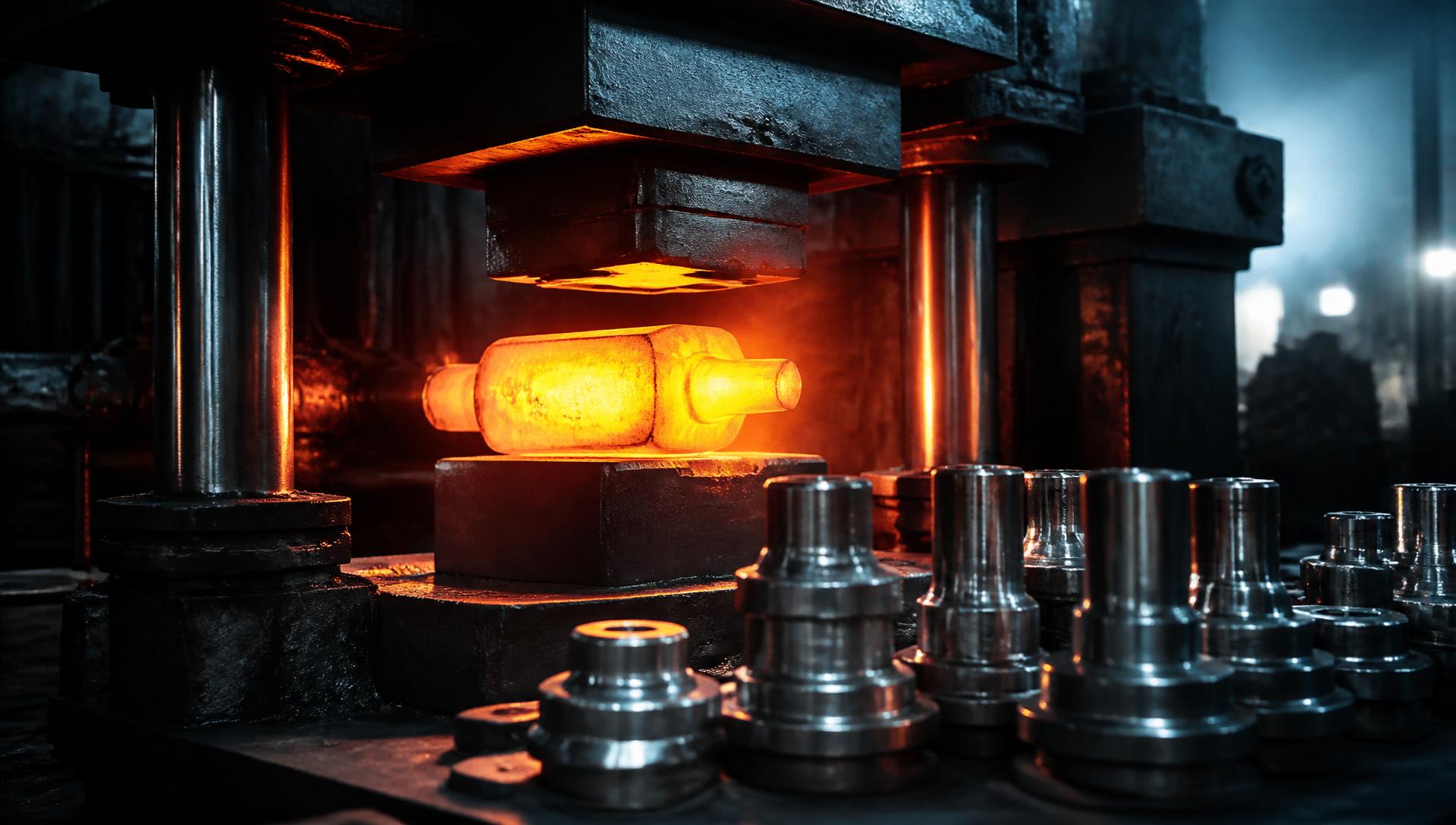
Forging is the metal forming process that produces the strongest, most reliable components available in manufacturing. When a part must survive impact loads, fatigue cycles and extreme stress without failure, forging is the answer. By aligning the metal's grain structure along the contours of the part rather than cutting through it as machining does, forged components achieve strength levels that cast or machined equivalents simply cannot match.
Our forging operation integrates billet preparation, heating, forming, trimming, heat treatment and finish machining into a single streamlined workflow. This vertical integration eliminates the delays and quality gaps that occur when work passes between separate forging, heat treating and machining shops. Every forging is serialized and tracked through each process stage, giving you complete traceability from raw material certification to final dimensional inspection.
Post-Forging Services
Complete finishing under one roof: heat treatment (normalizing, quenching & tempering, solution annealing), shot blasting and descaling, CNC machining to final dimensions, and NDT inspection including ultrasonic, magnetic particle and liquid penetrant methods. Surface treatments include phosphating, zinc plating and protective coating systems for corrosive environments.
Forging Methods We Use
Hot Forging (Closed / Impression Die)
Billets heated to 1100–1250 °C are shaped between precisely machined die halves under hydraulic or mechanical press force. Grain flow follows the part contour, maximizing mechanical properties in critical load paths. Used for connecting rods, steering knuckles, gear blanks and structural fittings.
Cold Forging
Material formed at room temperature produces excellent surface finish (Ra 0.8–1.6 μm as-forged) and tight tolerances (±0.05 mm). Work hardening increases yield strength by 20–50%. Ideal for fasteners, bearing races, pinion gears and small shafts in high volumes.
Warm Forging
Operates in the 600–900 °C range, balancing the formability of hot forging with the precision of cold forging. Reduces energy costs and scale formation while achieving intermediate tolerances.
Open Die Forging
For large components exceeding closed-die press capacity — shafts up to 15 m, rings up to 5 m diameter and blocks weighing several tons. Used in shipbuilding, power generation and heavy press equipment.
Forging Materials
Carbon Steel (C20, C45, C55, 1045, 1050)
General-purpose structural forgings requiring moderate strength — levers, brackets and agricultural implement parts.
Alloy Steel (42CrMo4/4140, 34CrNiMo6/4340, 20MnCr5, 16MnCr5)
High hardenability and fatigue strength. Preferred for gears, shafts, crankshafts and heavy-duty automotive drivetrain components.
Stainless Steel (304, 316, 410, 17-4PH, Duplex 2205)
Corrosion-resistant forgings for chemical processing, marine hardware, food equipment and medical implants.
Micro-Alloyed Steels
Achieve target mechanical properties through controlled cooling rather than quench-and-temper, reducing cost and distortion risk.
Aluminum Alloys (6061, 7075, 2014)
Lightweight forged components for aerospace structural applications where every gram counts.
Key Application Industries
Automotive & Commercial Vehicles
Crankshafts, connecting rods, steering arms, axle beams, wheel hubs, transmission gears and CV joint components — routinely exceeding 500,000 fatigue cycles without failure.
Oil & Gas
Flanges, valve bodies, Christmas tree components, drill collars and BOP parts rated for pressures exceeding 15,000 PSI.
Railway
Axle boxes, coupling components, brake system levers and bogie frame connectors requiring 30+ year service life with minimal maintenance.
Mining & Heavy Equipment
Crusher shafts, excavator pins, dragline bucket components and mill trunnion shafts operating under continuous impact loading.
Power Generation
Turbine shafts, generator rotor forgings and valve stems for steam and gas turbine service at temperatures exceeding 550 °C.
Ready to work with Force Machining?
Send drawings, specs or a rough idea — our engineers get back within one business day.