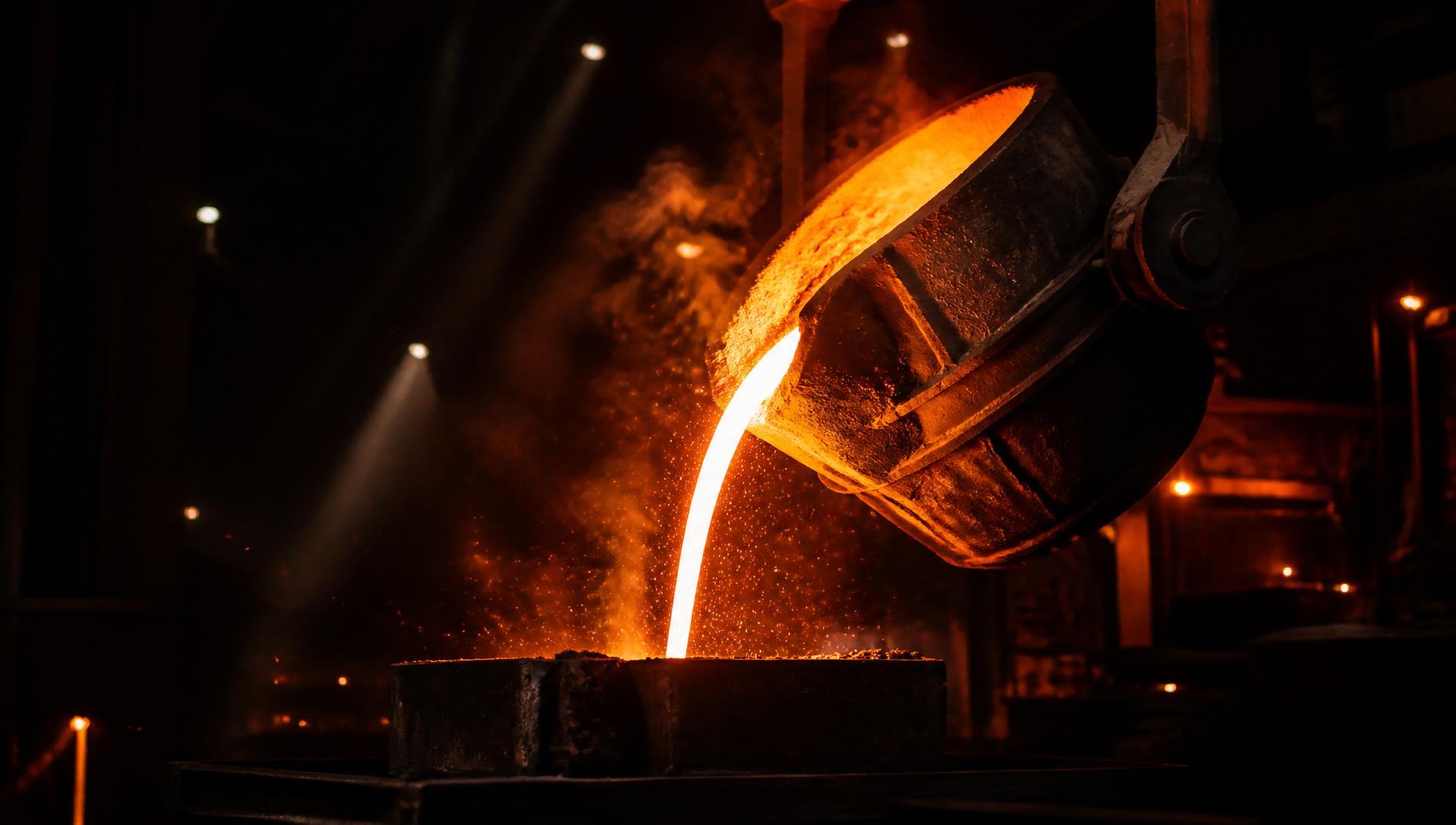
Continuous cast iron bar looks like ordinary steel round on the outside — but the way it is produced makes it a different material to work with. Instead of being poured into a sand mould that solidifies over minutes, iron is pulled continuously through a water-cooled graphite die that freezes the outer layer in seconds.
The result is a much denser, finer-grained microstructure with almost no porosity — the reason machine shops reach for continuous cast bar whenever a part must hold pressure, machine to a mirror finish or work harden reliably.
How continuous casting works
Molten iron sits in a holding furnace above the casting die. A servo-controlled puller withdraws the bar downward in small increments — 20 to 60 mm per stroke — allowing the die to refill and the outer layer to solidify each cycle. The bar leaves the die red-hot but structurally complete, ready to be cut to length and stress-relieved.
Why the microstructure is different
The high thermal gradient at the graphite die produces uniform, fine graphite flakes (grey iron) or spheroids (ductile iron) throughout the section — no chill zone, no coarse core, no shrinkage cavities. That uniformity is what gives continuous cast bar its predictable machinability and its ability to hold hydraulic pressure without impregnation.
When you should specify it
- Hydraulic manifolds and valve bodies — no porosity, no leaks.
- Mould bases and die sets — flat, stable, low-distortion after machining.
- Metallurgical rolls, bushings and gears — consistent hardness through-section.
- Any job where a sand-cast blank would need impregnation or excessive over-material.
- Continuous cast iron bar has finer grain and near-zero porosity vs. sand casting.
- It machines to a mirror finish and holds pressure without impregnation.
- Available in both grey (EN-GJL) and ductile (EN-GJS) grades.
- Best fit for hydraulics, moulds, rolls and general engineering blanks.