Continuous Cast Iron Bar — Complete Guide
Grey and ductile iron bar produced by continuous casting — how it's made, why it out-machines sand-cast blanks, and how to specify it for hydraulics, moulds and metallurgical rolls.
Start here
Continuous cast iron bar is a semi-finished product pulled continuously from a water-cooled die instead of poured into a sand mould. The result is dense, fine-grained iron with almost no porosity — bar stock that machines to a mirror finish and holds pressure without impregnation.
This pillar page covers the metallurgy, the manufacturing line, the mechanical envelope and the buying checklist for cast iron bar. Use it to decide between grey and ductile grades, and to write a purchase specification that will not surprise you at incoming inspection.
Go to product rangeHow it's made
Melt & alloying
Charge is melted in medium-frequency induction furnaces; carbon, silicon, manganese and inoculants are trimmed to grade.
Continuous casting die
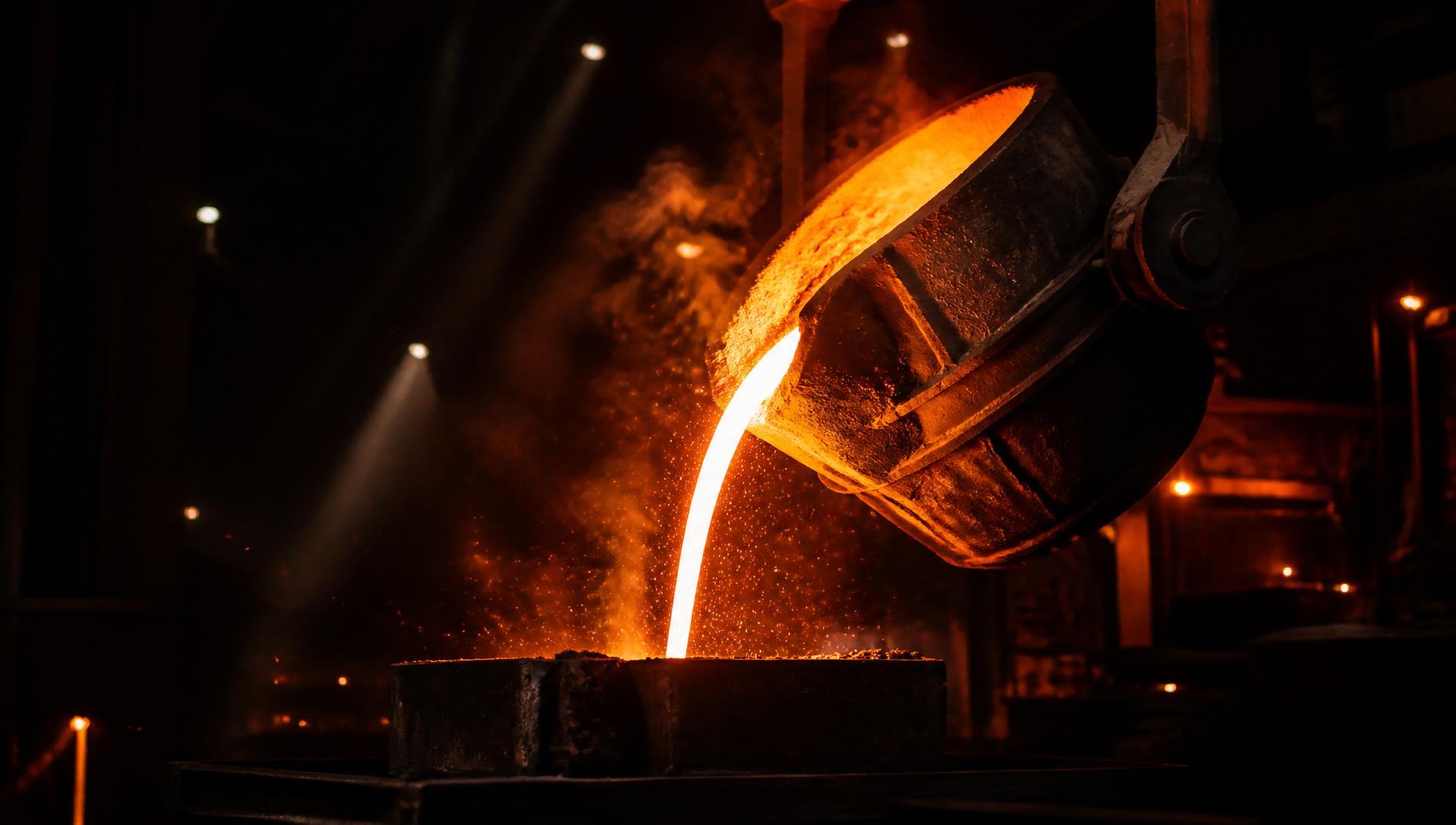
Iron is drawn through a graphite die in a water-cooled jacket, solidifying from the outside in under precise thermal control.
Withdrawal & cut-off
A servo-controlled puller sets bar length; hot saws cut to size and each bar is heat-numbered for full traceability.
Ageing & inspection
Bars are stress-relieved, ultrasonically tested and chemically verified against the mill certificate before shipment.
Where it's used
- Hydraulic manifolds & valve bodies
- Plastic injection mould bases
- Metallurgical rolls & rolling-mill spares
- Machine tool ways & bed sections
- Bushings, glands & pistons
- Sliding blocks & guide plates
- Gear blanks & sprocket blanks
- General-purpose engineering stock
Why buyers specify it
Zero porosity, holds pressure
Continuous solidification eliminates the shrink cavities and gas pockets that force sand castings to be impregnated.
Superior machinability
Fine, uniform graphite structure produces short chips and delivers a mirror finish straight off the tool.
Consistent hardness through section
No skin-to-core hardness drop — every millimetre of bar behaves the same on the tool.
Immediate stock availability
Cut to length from standard round, square and hollow bar — no pattern-making, no minimum casting run.
Codes we build to
- EN 1561 — grey cast iron (EN-GJL-200 to EN-GJL-350)
- EN 1563 — ductile cast iron (EN-GJS-400 to EN-GJS-700)
- ASTM A48 & ASTM A536 equivalents
- DIN 1691 GG25/GG30 · DIN 1693 GGG50/GGG60
- EN 10204 3.1 mill certificate on every heat
Technical envelope
Diameter range | 20 mm – 600 mm round · 20–500 mm square · 40–400 mm hollow |
|---|---|
Length | Standard 2,000 mm; cut-to-length 200–3,000 mm |
Grades | GG20, GG25, GG30, GG40 (grey) · GGG40, GGG50, GGG60, GGG70 (ductile) |
Tensile strength | 200 – 700 MPa depending on grade |
Hardness | 180 – 280 HB typical |
Surface | Skin-turned, ground or as-cast |
Specify with confidence
Grey or ductile?
Grey iron for damping and machinability (moulds, sliding surfaces); ductile iron for strength and impact resistance (rolls, gears).
Round, square or hollow?
Hollow bar saves 30–60% of machining time on large bushings and pistons — pick it whenever the finished part has a bore.
Diameter oversize
Add 3–6 mm to nominal diameter for skin turning; 0.5–1 mm extra when ordering ground bar.
Certification level
Standard 3.1 mill certificate covers chemistry, tensile and hardness. Add UT report for pressure-critical parts.
Common questions
The questions our sales engineers hear most often about this product family.
Datasheets & guides
Continue across the Knowledge Center
Talk to an engineer
Share drawings, specifications or a rough concept — a real engineer replies within one business day.
Ready to work with Force Machining?
Send drawings, specs or a rough idea — our engineers get back within one business day.