Material Comparison

Ductile Iron vs. Aluminium

Weight against stiffness. When lightweighting justifies aluminium and when ductile iron remains the sounder engineering choice.

Quick Answer

Ductile iron vs. Aluminium alloys

Aluminium alloys are roughly a third the density of ductile iron and conduct heat far better, which makes them the default where mass or heat dissipation dominates. Ductile iron has a much higher elastic modulus, so an iron part is considerably stiffer than an aluminium part of the same geometry, and it damps vibration better and resists wear more effectively. Aluminium forms a protective oxide and needs no paint in many environments; unprotected iron rusts. Choose aluminium for lightweight, thermally active or corrosion-exposed parts; choose ductile iron for stiff, heavily loaded, wear-exposed or vibration-sensitive components.

This comparison sits behind most lightweighting programmes in machinery, automotive and handling equipment. It is rarely a straight swap, because reducing mass while keeping stiffness usually forces a geometry change — thicker walls, deeper ribs, different fastening.

Aluminium alloys are standardised in EN 573 and EN 485/EN 755 for wrought forms and ASTM B221 for extrusions, with tempers such as T6 designating heat treatment condition; ductile iron is covered by EN 1563 and ASTM A536.

Reference Standards
  • EN 1563 / ASTM A536 — ductile iron
  • EN 573 — aluminium alloy designation
  • EN 755 / ASTM B221 — extruded aluminium bar and profiles
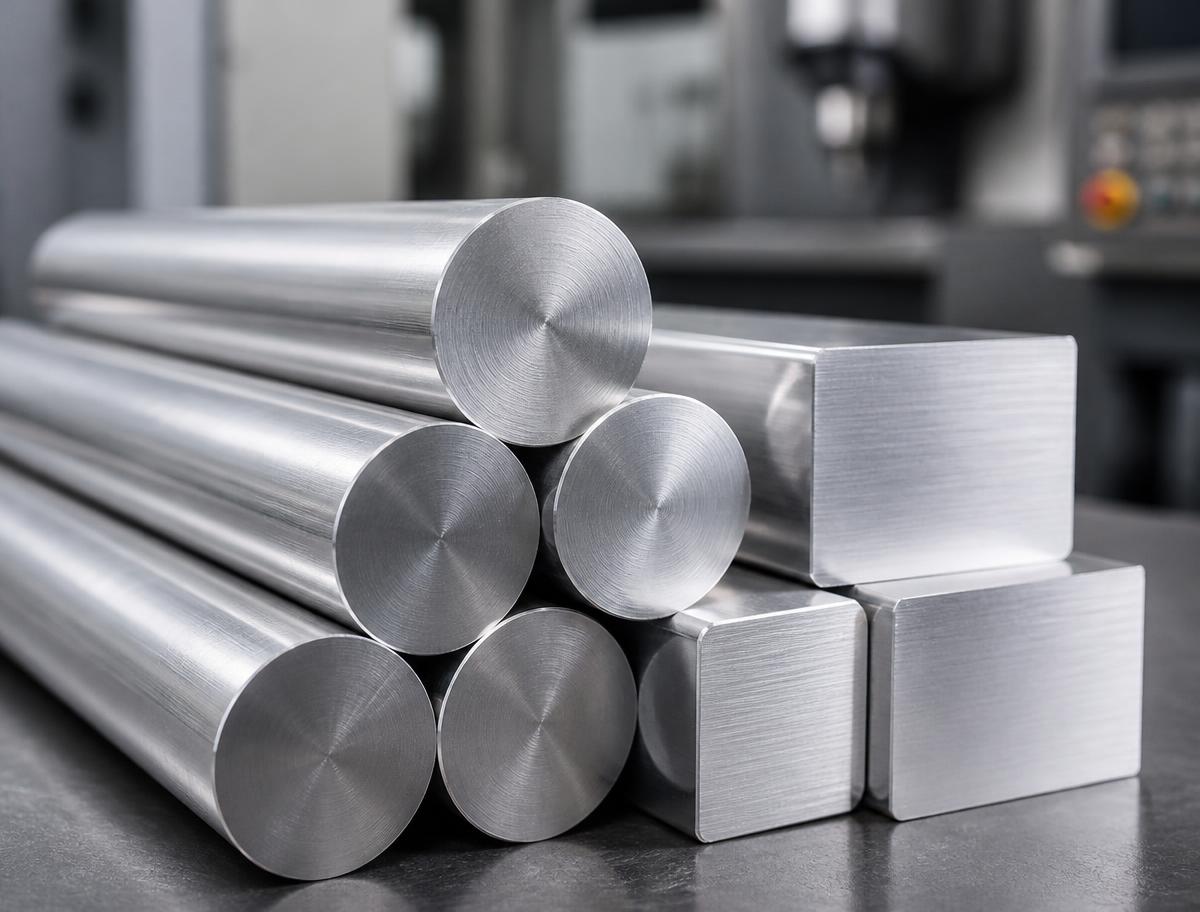
Aluminium bar stock and machined aluminium components
Detailed Comparison

Understanding the difference

COMP. 01 // ANALYSIS
SEC. 01

Density And Stiffness

Aluminium's low density is its defining advantage — approximately one third that of iron — which directly reduces inertia, handling effort, shipping mass and energy consumption in moving assemblies.

Ductile iron's elastic modulus is far higher, so for the same shape it deflects much less under load. A stiffness-critical aluminium redesign therefore has to add section, ribs or depth, which claws back part of the weight saving and consumes package space.

  • Aluminium: roughly one third the density of iron; excellent for moving and portable assemblies.
  • Ductile iron: much higher modulus; superior stiffness for the same envelope.
  • A like-for-like substitution rarely works — expect to redesign the section.
SEC. 02

Thermal And Corrosion Behaviour

Aluminium conducts heat several times better than cast iron, which is why heat sinks, coolers and many housings that must shed heat are aluminium. Its higher coefficient of thermal expansion, however, must be accounted for in fits, clearances and mixed-material assemblies.

Aluminium forms a self-repairing oxide film that gives good atmospheric corrosion resistance and can be enhanced by anodising. Ductile iron requires paint, coating or plating in humid or wet service.

SEC. 03

Wear, Damping And Service Life

Cast irons resist sliding wear better than most aluminium alloys and damp vibration more effectively. Where an aluminium housing has to carry a sliding or rotating interface, the design usually needs a steel or bronze insert, an iron liner, or a hard surface treatment.

Ductile iron also tolerates local overload and point loading at bolted joints better, which simplifies mounting arrangements and reduces the need for load-spreading hardware.

  • Aluminium bearing or wear surfaces normally require inserts, liners or surface treatment.
  • Cast iron damps vibration and resists wear without added components.
  • Bolted joints in aluminium often need washers, inserts or controlled torque.
SEC. 04

Production And Cost

Aluminium machines quickly, at high cutting speeds and with low tool wear, and it is available as extrusions, plate, bar and castings. That combination supports fast prototyping and light, complex profiles.

Ductile iron is cheaper per kilogram and casts complex shapes economically at volume. Comparing costs only makes sense on the finished part, taking into account material, machining time, surface protection, inserts and assembly.

Comparison Table

Factor-by-factor overview

COMP. 02 // TABLE
FactorDuctile ironAluminium alloys
Relative densityHigh — reference iron densityApproximately one third of iron
Elastic modulusMuch higher — stiffer part for the same shapeRoughly one third of iron
Thermal conductivityModerateSeveral times higher
Thermal expansionLowerHigher — affects fits and clearances
Corrosion resistanceRequires coating or paintProtective oxide; anodising available
Wear resistanceGoodGenerally requires inserts or treatment
Vibration dampingGoodLower
MachinabilityGoodExcellent at high cutting speeds
Typical standardsEN 1563, ASTM A536EN 573, EN 755, ASTM B221
Relative material costLower per kilogramHigher per kilogram, lower per unit volume
Typical Applications

Where each option is normally used

COMP. 03 // APPLICATIONS

Ductile iron

  • Machine housings and gearbox casings
  • Hubs, crankshafts and loaded links
  • Pressure-retaining valve and pump bodies
  • Wear-exposed structural components
  • Vibration-sensitive machine structures

Aluminium alloys

  • Lightweight brackets and frames
  • Heat sinks and cooling components
  • Portable and handheld equipment housings
  • Extruded profiles and structural framing
  • Corrosion-exposed non-loaded parts
Advantages & Limitations

Honest trade-offs on both sides

COMP. 04 // TRADE-OFFS

Ductile iron

Advantages
  • High stiffness within a compact envelope
  • Good wear resistance without inserts
  • Better vibration damping
  • Lower cost per kilogram
  • Casts complex shapes economically at volume
Limitations
  • Heavy — poor choice for moving or portable assemblies
  • Requires corrosion protection
  • Lower thermal conductivity than aluminium
  • Slower machining than aluminium

Aluminium alloys

Advantages
  • Very low mass for the same volume
  • Excellent thermal conductivity
  • Good natural corrosion resistance
  • Fast, low-wear machining
  • Available as extrusions, plate, bar and castings
Limitations
  • Low stiffness — needs added section to match iron
  • Limited wear resistance without treatment
  • Higher thermal expansion complicates fits
  • Higher price per kilogram
  • Lower damping capacity
How To Choose

Material-selection considerations

COMP. 05 // SELECTION
  • 01Is mass a primary design driver, as in moving, rotating or portable assemblies? Evaluate aluminium first.
  • 02Is deflection or stiffness critical in a fixed envelope? Ductile iron usually wins without redesign.
  • 03Does the part have to shed heat? Aluminium's conductivity is a decisive advantage.
  • 04Is there a sliding, rotating or wear interface? Either use ductile iron or plan inserts and surface treatment in aluminium.
  • 05Compare finished-part cost including coating, inserts and assembly — not price per kilogram.

Practical Conclusion

Aluminium buys mass and thermal performance; ductile iron buys stiffness, wear resistance and damping. Treat any substitution as a redesign rather than a material swap, verify deflection and wear behaviour against the real load cases, and compare cost at the level of the finished, protected, assembled part.

Discuss Your Component
FAQ

Frequently asked questions

COMP. 06 // FAQ

Start a project

Ready to work with Force Machining?

Send drawings, specs or a rough idea — our engineers get back within one business day.